
Senior with PEG tube or catheter: What a caregiver can do and what a nursing service must provide?
Caring for a bedridden patient in Germany raises the question of where the caregiver's basic duties end and when the nursing service (Pflegedienst) is needed. Find out how responsibilities are divided for urinary catheters or PEG tubes, why these procedures are outside the scope of self-employment, and how our support can help you choose a verified family.
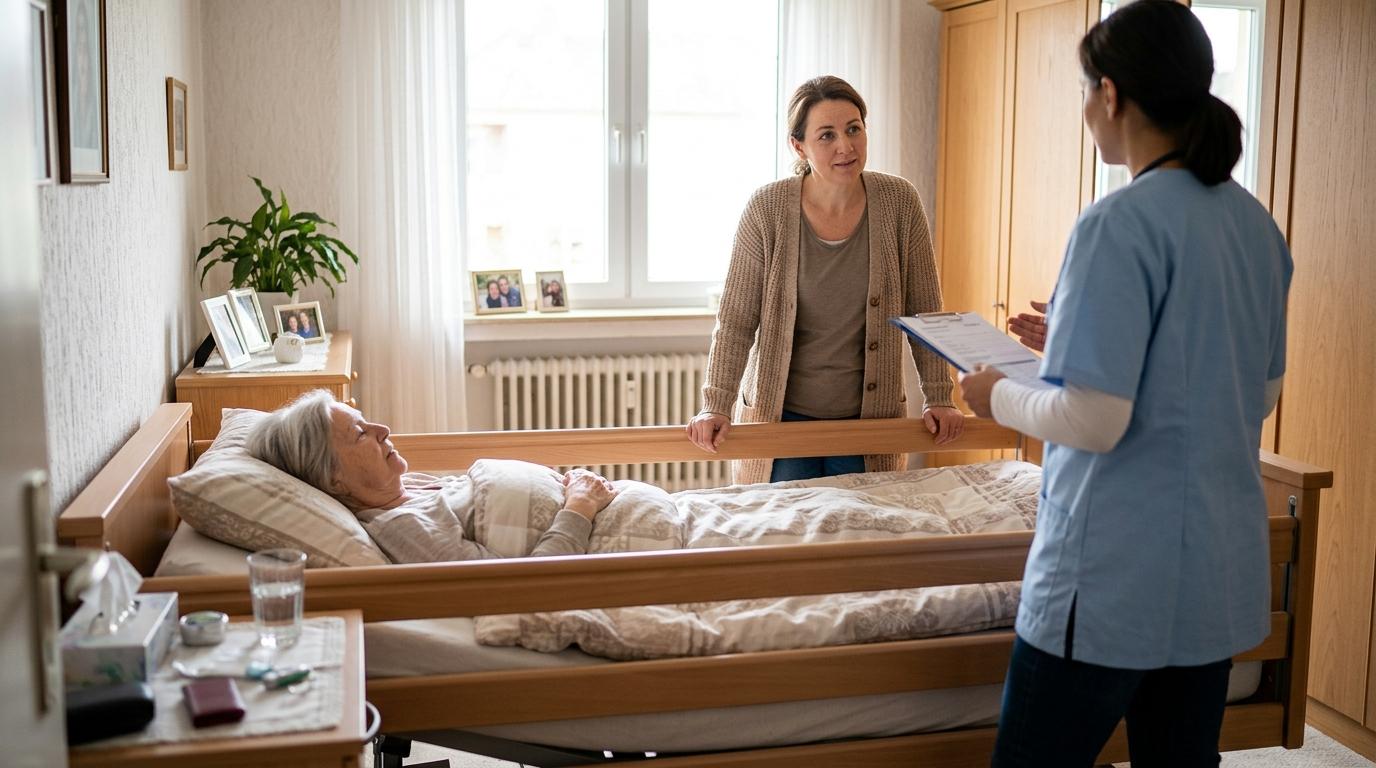
Can a German family ask you to handle a PEG tube or change a urinary catheter?
As a live-in caregiver, a German family cannot ask you to change a urinary catheter or professionally care for a PEG tube insertion site, as these activities go beyond basic care. According to Section 37 of the German Social Code Book V (SGB V), medical care (Behandlungspflege) is covered by health insurance if there is no one in the household who can safely perform it. A caregiver operating as a self-employed individual provides basic care (Grundpflege) and household help, not professional medical treatments.
For a urinary catheter, a caregiver's typical tasks include emptying the collection bag, monitoring urine output, and maintaining genital hygiene. However, changing a permanent catheter, flushing the bladder, or caring for a suprapubic insertion site requires sterile supplies and professional procedures. Any unprofessional manipulation of the catheter can lead to urethral injury and the introduction of a bacterial infection, both of which directly endanger the senior's health.
Percutaneous endoscopic gastrostomy (PEG) is used to administer enteral nutrition and fluids directly into the patient's stomach. A live-in caregiver, after proper training by the family or a healthcare professional, can administer prepared nutrition via a gravity set or enteral pump and monitor tube patency. However, they must not perform sterile dressing changes of the stoma site, change the fixation pad, unblock a clogged tube with aggressive pressure, or treat inflamed tissue around the insertion site.
The division of these tasks is clearly defined by legislation. According to the G-BA guideline on home nursing care, bladder irrigation (procedure no. 9), care of a suprapubic catheter (procedure no. 22), and PEG stoma care (procedure no. 27) are considered medical treatments requiring professional staff. Conversely, administering nutrition via a tube (procedure no. 3) and assistance with emptying, including changing the collection bag (procedure no. 2), are classified as Grundpflege in the guideline.
Patient TaskCaregiver (Grundpflege)Nursing Service and Doctor (Behandlungspflege)Emptying the collection bag and hygiene (HKP-RL No. 2)Permitted if cleanliness is maintainedNot required if the household can manage the taskInsertion and every change of a suprapubic catheter (HKP-RL No. 23)Caregiver must not performMedical procedureBladder flushing (HKP-RL No. 9)Caregiver must not performMedical procedure prescribed by a doctorAdministering prepared nutrition via PEG (HKP-RL No. 3)Possible after in-home trainingProvided for complicated patient conditionsStoma site care and dressing for PEG (HKP-RL No. 27)Caregiver must not performSterile dressing and professional stoma inspectionHandling a dislodged or blocked PEG tubeStrictly prohibited, call for assistanceImmediate professional medical intervention
What tasks for a bedridden patient fall exclusively under the German Pflegedienst?
Invasive and medical procedures requiring a prescription necessitate sterile techniques or specialized qualifications, thus they are provided by a professional nursing service. According to § 37, paragraph 3 of the SGB V, a condition for entitlement to reimbursement of medical care is whether it can be performed by a person living in the household. This is a condition for reimbursement, not an authorization to perform the tasks. This section does not mention training or family members, nor does it exclude a caregiver residing in the household.
In the German healthcare system, certain specific procedures are exclusively reserved for doctors. According to the note under item no. 23 of the HKP-RL guideline, the insertion and every change of a suprapubic urinary catheter are medical procedures, not just the first change. Routine changes of a transurethral permanent catheter and sterile wound care may be performed by qualified mobile nursing service staff (Pflegefachkraft). A caregiver from Slovakia does not provide these invasive procedures at home, as they do not possess German recognition of their medical qualifications.
Mobile Pflegedienst provides a wide range of medical services according to the catalog of the Federal Joint Committee. This includes administering subcutaneous or intramuscular injections of insulin and heparin (item no. 18), preparing and dispensing medications into weekly pill organizers (item no. 26), and repositioning for bedsore treatment (item no. 12), which can be prescribed from stage 1. Nurses also provide sterile dressings for diabetic wounds and check skin condition for possible infections.
All these professional activities must be prescribed by a German doctor on the official form Muster 12 according to the Kassenärztliche Bundesvereinigung, which serves as a referral for home nursing care. The costs for these services are covered by statutory health insurance. The patient pays a legally mandated co-payment of 10% of the care costs for a maximum of the first 28 days in a calendar year and a fee of 10 euros for each medical prescription.
In 2027, the fee for a medical prescription will increase from 10 euros to 15 euros, as confirmed by the overview from the health insurance company Techniker Krankenkasse.
What are the risks of unprofessional medical interventions at home?
Performing professional medical tasks without German qualification recognition exposes the caregiver to civil liability for health damages. Although the desire to help the senior and relieve the family is understandable from a human perspective, in case of complications, the consequences are borne by the person who performed the procedure. The extent of professional liability insurance depends on the specific insurance policy, and invasive medical treatments may not be covered.
An extremely serious risk involves the dislodgement, blockage, or accidental pulling out of a feeding tube from the abdominal wall. An amateur attempt to forcefully reinsert a dislodged tube into the opening can injure the stomach wall and cause fluid leakage into the abdominal cavity. Such a condition leads to acute peritonitis, which, without immediate medical intervention, is life-threatening for the patient.
What to do if the family refuses to call a nursing service and expects medical procedures from you?
If a German family refuses to call a nursing service and expects medical procedures from you, politely but firmly decline these requests and contact your agency immediately. Never yield to pressure or the claim that a previous caregiver did it without issues. Your priority remains protecting your own legal certainty and the safety of the senior entrusted to your care.
Explain the situation to the relatives calmly and factually, referring to German regulations and contractual terms. You can use the proven phrase in German: "Ich bin als Betreuungskraft tätig und darf aus rechtlichen Gründen keine medizinische Behandlungspflege übernehmen." At the same time, reassure the family that you care about the senior's health, but precisely because of this, sterile stoma dressings or catheter changes must be provided by qualified personnel to prevent infections.
The reluctance of relatives to call the Pflegedienst often stems solely from ignorance and fear of high monthly fees. Calmly remind relatives that the costs for home nurse visits based on a doctor's prescription are covered by health insurance. The family only pays the legally regulated co-payment.
If the family, despite your arguments, refuses to contact a doctor or nursing service, immediately contact your coordinator. DYMA ensures telephone and in-person support throughout your work tour in Germany. Our coordinator will connect with the family, diplomatically clarify contractual boundaries, and help set up care so that professional tasks are properly covered by the local Pflegedienst.
How to choose a safe tour with a bedridden senior and what to prepare for?
You can ensure a safe tour with a bedridden senior by choosing an agency that verifies the patient's condition in advance and clearly defines your duties. Before starting a tour, you must know the client's level of need (Pflegegrad), their diagnoses, and which tasks are handled by the family or outpatient services. Thorough preparation will prevent misunderstandings on-site and allow you to fully concentrate on quality care.
DYMA mediates verified families for caregiving in Germany, with each request thoroughly vetted by our coordinator in collaboration with an automated AI Guide. Thanks to this process, you will know the senior's condition before starting and which tasks are covered by the Pflegedienst. Caring for a bedridden patient in Germany thus proceeds transparently, under safe conditions, and without fear of undue demands.
All mediation services are provided to caregivers completely free of charge, with no hidden fees or deductions from wages. We assist with complete administration, including obtaining a business license, the PD A1 form, and preparing all contractual documentation. We will organize your travel and reimburse travel costs with an agreed lump sum. Furthermore, DYMA directly invoices the client for the care, so you do not deal with financial settlements directly with the family.
Our caregivers have completed a caregiving course and have a B2 level of German, ensuring confidence in communication with the senior, family, and German doctors. You gain the backing of a reliable partner with whom we are with you even in Germany. If you want to learn more about the necessary requirements before traveling, read our article about what you need for caregiving in Germany. For a secure selection of a verified family, visit DYMA s.r.o., where we will gladly help you plan your next tour.
Interested in caregiving abroad?
Browse current offers in Germany and the Netherlands or register with no obligation.