
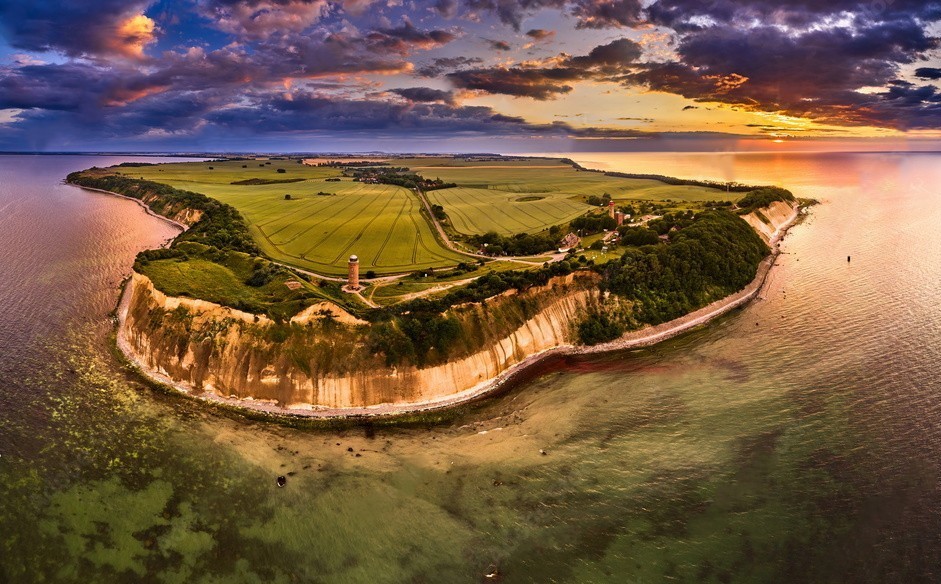
Today we take you to a literally mystical place that is one of the northernmost points of Germany. Kap Arkona is a dramatic headland on the Baltic coast, formed by majestic chalk cliffs up to 45 metres high, offering spectacular views of the sea and surrounding landscape. This natural phenomenon lies on the Wittow peninsula in the north of the German island of Rügen, part of the state of Mecklenburg-Vorpommern, and is one of Germany’s northernmost points.
The cape is not accessible by car. The central car park is located in the village of Putgarten, about 2.5 km from the lighthouses. From there you can reach the sights on foot, or use the Kap-Arkona train or horse-drawn carriage as a shuttle service.
Arkona is home to several significant landmarks, including two historic lighthouses. The oldest of these – the Schinkel Tower – was built in 1826 and is one of the main tourist attractions. Next to it stands a new lighthouse from 1905 – the Cape Arkona Lighthouse – which is still used for navigating ships and offers views of the entire Wittow Peninsula and the island of Rügen from above. There is also a former military fortress with naval bunkers in the area, which are now open as a museum and offer an insight into the history of German naval defence.
In this area, the picturesque nature is also breathtakingly beautiful. It’s not just the breathtaking cliffs themselves. You can easily walk down the purple steps from the cliffs to the rocky beach. From here you can admire the true majesty of the cliffs. If you’re very lucky, you might even catch a glimpse of the Northern Lights in the cold winter months. The cliffs are home to a large nesting colony of brown boobies. However, you can also see many other birds that live along the Baltic Sea coast.
Near the cape is the fishing village of Vitt, famous for its picturesque, traditional thatched-roof houses. This historic village is the perfect place to stroll and sample fresh fish in the local restaurants.
Mecklenburg-Vorpommern has a coastline of 1,700 km, making it the longest coastline in Germany. It lies in the north-east of Germany, bordering the Baltic Sea to the north, Brandenburg to the south and Poland to the east. Part of the Mecklenburg Lake District is Lake Müritz, which is one of the largest lakes in Germany. The lake surroundings are part of the Müritz National Park, which offers rich fauna and flora. This park is a popular place for hiking, cycling and birdwatching. The diversity of protected nature in Mecklenburg-Vorpommern extends over 3 national parks, 3 biosphere reserves as well as many other nature parks protected areas and covers 30% of the total territory. Other important parks are the Jasmund National Park and the Lagoon National Park.


